top of page
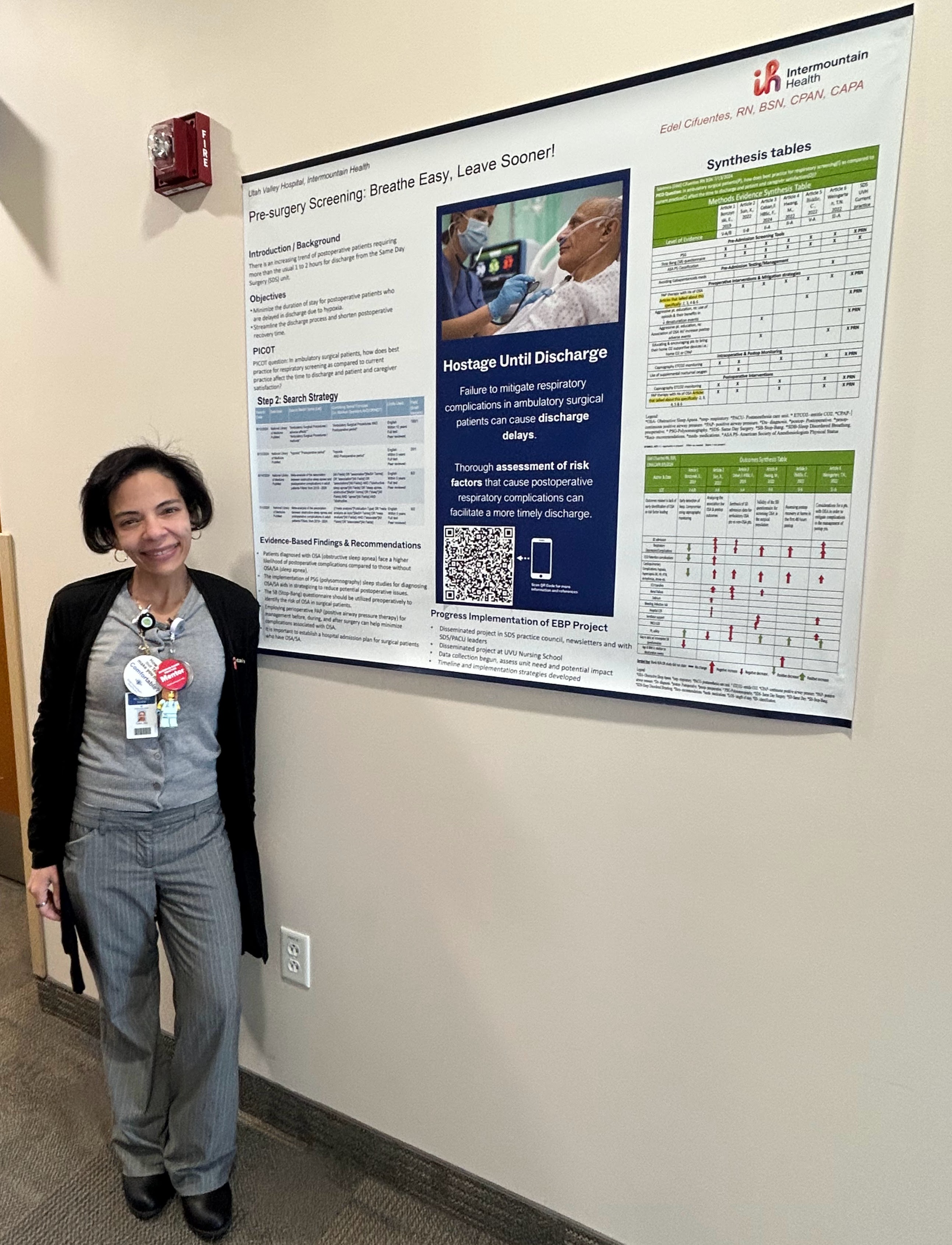
Pre-surgery Screening: Breathe Easy, Leave Sooner! Evidence Based Practice Project
Purpose: Delays in postoperative discharges are often due to postoperative hypoxia, making it unsafe for patients to go home on room air. This project aimed to find best practices to mitigate these delays.
Rationale: A tertiary-level hospital observed that same-day surgery patients often had undiagnosed respiratory issues like obstructive sleep apnea (OSA), leading to postoperative hypoxia.
Methods: PubMed was searched for literature on adverse effects in post-surgical patients. Key terms searched were “hypoxia in the postoperative period”, “ambulatory surgical procedures/adverse effects”, and “Meta-analysis of the association between obstructive sleep apnea and postoperative complications in adult patients”. Initial results yielded 193 articles, which were narrowed down to 6 included in the project. The articles kept were those that exclusively discussed postoperative delays related to respiratory complications, with no other anesthesia-related consequences.
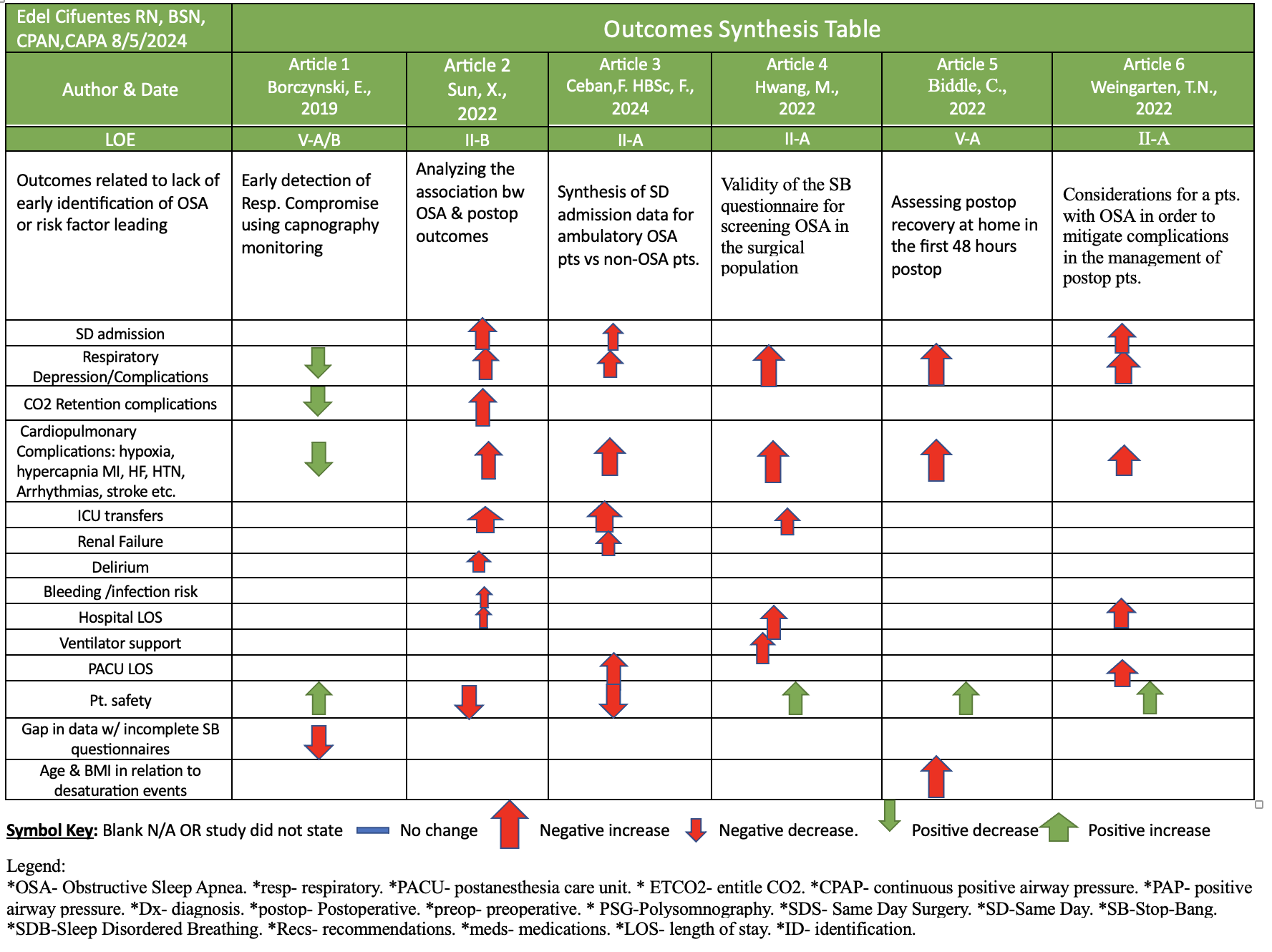
Results: Thorough assessment and preemptive intervention are crucial for minimizing respiratory complications in patients with OSA. OSA increases the risk of cardiopulmonary complications, ICU transfers, delirium, bleeding, and prolonged hospital stays. Identifying OSA through Polysomnography or the STOP-Bang questionnaire (score >3 indicates high risk) is essential. Postoperative patients with moderate to severe OSA are at risk for CO2 retention, which can be monitored using capnography. The most effective intervention is perioperative Positive Airway Pressure (PAP) therapy, including CPAP or BiPAP, depending on patient needs.
Significance: Based on the evidence, patients with OSA have a greater risk of postoperative complications. However, early detection of risk for OSA using Polysomnography as a standard tool for OSA diagnosis helps to plan accordingly and mitigate potential postoperative complications. Using the Stop Bang questionnaire preoperatively is an alternative screening tool to detect OSA risk in surgery patients on the day of surgery. The use of perioperative PAP therapy for preoperative, intraoperative, and postoperative management of OSA can help mitigate and decrease the severity of respiratory complications.
Next Steps:
1. Train staff on capnography equipment and consistent preoperative OSA assessment using the STOP Bang questionnaire.
2. Educate nursing staff on perioperative PAP therapy to ensure best practices and mitigate postoperative respiratory complications.
3. Implement positive airway pressure therapy perioperatively to reduce desaturation events in the first 48 hours after surgery for all diagnosed OSA patients and those with STOP-Bang scores >3.
Legend:
*OSA- Obstructive Sleep Apnea. * ETCO2- entitle CO2. *CPAP- continuous positive airway pressure. *Dx- diagnosis. *postop- Postoperative. *preop- preoperative. * PSG-Polysomnography. *SDS- Same Day Surgery. *SB-Stop-Bang. *DOS-day of surgery. *ASA- American Society of Anesthesiologists. *SDB-Sleep Disordered Breathing.
Reference List:
1: Borczynski, E., & Worobel-Luk, P. (2019). Capnography monitoring of patients with obstructive sleep apnea in the post-anesthesia care unit: a best practice implementation project.
2: Sun, X., Yu, J., Luo, J., Xu, S., Yang, N., Wang, Y. (2022). Meta-analysis of the association between obstructive sleep apnea and postoperative
3: Ceban, HBSc, F., Yan, HBSc, E., Pivetta, MD, B., Saripella, MSc, A., Englesakis, MLIS, M., Gan, MD, T., Girish, MD P., & Chung, MD, F. (2024) Perioperative adverse events in adult patients with obstructive sleep apnea undergoing ambulatory surgery: An updated systematic review and meta-analysis
4: Hwang, M., Nagappa, M., Guluzade, N., Saripella, A., Englesakis, M., & Chung, F. (2022) Validation of the STOP Bang questionnaire as a preoperative screening tool for obstructive sleep apnea: a systematic review and meta analysis
5: Biddle, C., Elam, C., Lahaye, L., Kerr, G., Chubb, L., & Verhulst, B. (2022) Predictors of At-Home Arterial Oxygen Desaturation Events in Ambulatory Surgical Patients
6: Weingarten, T.N. & Sprung, J. (2022) Perioperative considerations for adult patients with obstructive sleep apnea
7: Gupta, K., Prasad, A., Nagappa, M., Wong, J., Abrahamyan, L., & Chung, F., (2018) Risk factors for opioid-induced respiratory depression and failure to rescue: a review
8: Weingarten, T.N., Warner, L.L, & Sprung, J., (2017) Timing of postoperative respiratory emergencies: when do they really occur?
Project type
Evidence Based Practice Project
Date
9/30/2025 and still on-going
Location
Provo, Utah at Utah Valley Hospital

01
Pre-surgery Screening: Breathe Easy, Leave Sooner! Evidence Based Practice Project

01
IMG_6851

02
outcomes synthesis table Screenshot 2025-04-10 at 12.58.38 PM
03
ETCO@ & CPAP Video Inservice-20250403_101156-Meeting Recording
bottom of page